
Food manufacturers cannot estimate a coating project from one breading machine price alone. The automatic onion ring and mozzarella stick coating line cost factors include product size, hourly capacity, belt width, predusting requirements, batter type, crumb specification, coating pickup, automation level, and connection with the fryer or freezer. Onion rings need controlled spacing and complete surface coverage, while cheese sticks need gentle handling and reliable coating protection around edges and ends. Therefore, snack factories, frozen food manufacturers, central kitchens, supermarket suppliers, chain restaurants, and equipment buyers should evaluate the complete food coating process before they compare quotations or set an investment budget.
How Do Raw Materials and Product Specifications Change Coating Line Cost?
Raw material behavior determines the required food preparation system. Fresh or frozen onion rings can carry surface water, uneven edges, or fragile structures after cutting and separation. Mozzarella sticks can vary in temperature, dimensions, firmness, and surface condition, and warm cheese may create handling problems before frying. A factory may need controlled thawing, draining, chilling, predusting, or buffer conveying before battering. Moreover, the recipe may use flour, starch, egg wash, thin slurry, thick batter, fine crumbs, coarse crumbs, or multiple coating layers. Each added procedure requires suitable machinery, labor control, floor space, cleaning time, and material management. Consequently, the supplier needs actual product samples or detailed specifications before the team can calculate a realistic equipment cost.
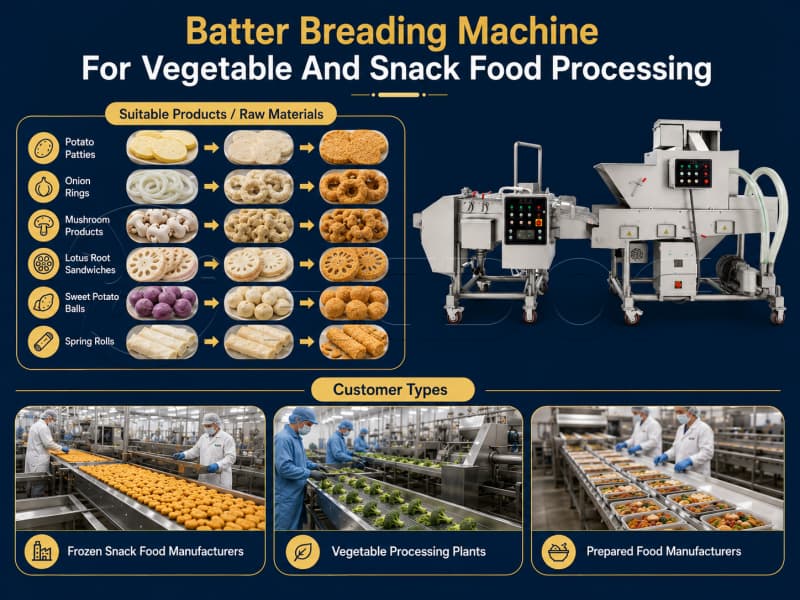
Batter Breading machine for Vegetable and Snack Food Processing
Which Battering Machine Fits Onion Rings and Mozzarella Sticks?
A waterfall batterer applies a batter curtain across the top while the lower tank coats the product bottom. This machine can suit free-flowing slurry when onion rings or cheese sticks maintain stable positions on the conveyor. A submerging batterer uses upper and lower belts to guide products through a deeper tank, so the mechanism can control lightweight or floating products and coat recessed surfaces more consistently. Buyers should match the battering technique to batter viscosity, product density, coating thickness, and required pickup. In addition, belt width and conveying speed affect capacity and price. Wider 400, 600, or 1,000 mm machinery requires more stainless steel, larger pumps, stronger drives, and greater factory area than compact coating equipment.
How Does Predusting and Breading Equipment Affect the Investment Budget?
Some onion ring and mozzarella stick recipes need predust before wet batter because the dry layer helps manage surface moisture and supports adhesion. The line may then use an automatic breader to apply fine crumbs, Japanese-style crumbs, flour mixtures, or other dry coatings to the top and bottom surfaces. A crumb elevator, upper curtain, lower bed, press roller, vibrator, and air knife can improve crumb circulation and excess-material removal. However, every component adds purchase price, power demand, cleaning work, and maintenance responsibility. A single-pass food coating machine may suit a simple product, while a predust-batter-bread or double-pass coating process may better support thicker shells and demanding frozen snack manufacturing.
Why Must Buyers Connect Coating Equipment With the Frying Process?
The coating line does not operate as an isolated food treatment section. Conveyor height, transfer distance, belt speed, product spacing, and fryer entry conditions influence whether wet batter and crumbs remain on the onion rings or cheese sticks. A continuous frying equipment system for coated snacks can connect coating, frying, oil filtration, deoiling, cooling, freezing, and packaging machinery into a coordinated production flow. Product style also matters because mozzarella sticks as breaded cheese snacks need a coating structure that limits cheese leakage during heat treatment. Therefore, a buyer should include transfer conveyors, fryer belt width, oil management, exhaust, cooling, and downstream handling when the project team evaluates the complete food production investment.
What Capacity, Belt Width, and Automation Level Influence the Final Quotation?
Higher throughput changes more than the motor size. A larger factory may need wider battering and breading belts, faster crumb recovery, continuous batter mixing, automatic replenishment, synchronized controls, longer conveyors, and stronger downstream frying capacity. A compact line can reduce the initial budget for market trials or regional food production, while a 500 kg/h or larger system may support supermarkets, chain catering suppliers, and industrial frozen food manufacturing. Buyers who request industrial battering and breading equipment for cheese sticks and onion rings should provide product dimensions, unit weight, target output, coating recipe, pickup target, voltage, workshop size, and preferred automation. The supplier can then prepare a conditional price range instead of an incomplete machine-only quotation.
How Should Procurement Teams Compare Automatic Coating Line Prices?
A procurement team should compare equal scopes. One quotation may cover only a batterer and breader, while another may include a mixer, preduster, crumb recycling, conveyors, fryer connection, oil filter, deoiler, cooling section, quick freezer, and packing equipment. The team should also review food-contact materials, effective belt width, adjustable parameters, sanitation access, control system, spare parts, delivery terms, installation responsibilities, and training scope. Furthermore, Fried Food Solutions production line engineering gives project buyers a reference point for integrating coating machinery with a broader fried food manufacturing system. This comparison method helps investors separate essential equipment from optional expansion modules and keeps the purchase decision within the approved budget.
Which Factors Create a Cost-Effective Onion Ring and Cheese Stick Line?
A cost-effective line matches the raw material, recipe, capacity, factory layout, and final product instead of maximizing every option. Product preparation controls surface condition; the batterer applies the wet layer; the breader manages dry coating; conveyors protect product spacing; the fryer sets the shell; and cooling or freezing stabilizes the final snack for packing and distribution. Consequently, buyers should ask for a process flow, equipment list, layout drawing, utility schedule, quotation scope, and excluded-item list. This structured food processing approach helps manufacturers control equipment price, operating cost, coating loss, cleaning labor, and future expansion without purchasing unnecessary machinery.
For product parameters and coating system details, customers can review https://www.friedfoodsolutions.com/automatic-batter-breading-machine/