
Biochar-based fertilizers are gaining attention as a sustainable solution for improving soil quality and recycling biomass resources. By combining biochar with compost and organic materials, manufacturers can create stable fertilizer pellets with higher commercial value. A properly designed biochar compost granulation system helps transform loose carbon materials into uniform granules suitable for storage, transportation, and agricultural application.
Prepare Biochar and Organic Materials Before Granulation
The first step in producing biochar fertilizer pellets is preparing suitable raw materials. Biochar can be produced from biomass resources such as agricultural residues, forestry waste, and organic by-products.
The quality of biochar directly affects the final fertilizer performance. Important factors include particle size, moisture content, carbon content, and compatibility with compost materials.
A complete biochar fertilizer processing plant usually integrates material crushing, mixing, moisture adjustment, granulation, drying, screening, and packaging systems.
According to the general concept of Biochar, biochar is a carbon-rich material produced from biomass through thermal conversion processes and is widely studied for soil improvement applications.
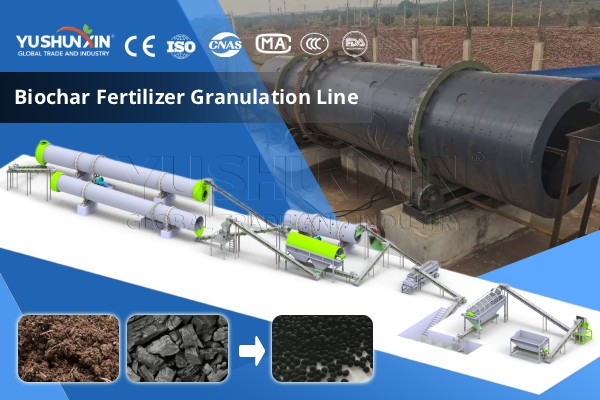
biochar fertilizer granulation line
Understand the Char-Based Fertilizer Granulation Process
The char based fertilizer granulation process focuses on combining biochar with compost and other organic ingredients to form stable fertilizer particles.
A typical process includes:
- Raw material crushing and preparation;
- Biochar and compost mixing;
- Moisture adjustment;
- Granulation;
- Drying and cooling;
- Screening and final packaging.
During granulation, the equipment controls particle formation by adjusting moisture, material ratio, and mechanical force. This helps produce fertilizer pellets with consistent size and better handling performance.
Select the Right Equipment Configuration
Different projects require different equipment combinations. Small producers may need a simple granulation system, while industrial projects require continuous production equipment with higher automation.
The main equipment may include:
- Compost crusher;
- Mixing machine;
- Fertilizer granulator;
- Rotary dryer;
- Screening machine;
- Automatic packing system.
The char-based fertilizer production line cost depends on factors such as production capacity, automation level, raw material conditions, equipment selection, and installation requirements.
Before investing, manufacturers should evaluate available biomass resources, target fertilizer products, production volume, and expected market demand.
Build a Sustainable Biochar Fertilizer Project
For companies developing carbon reduction and sustainable agriculture projects, biochar fertilizer production can connect waste utilization with agricultural applications.
Large-scale projects require more than individual machines. They need process design, equipment integration, installation support, and technical guidance.
For more information about biochar fertilizer production solutions, learn more here
A complete project approach can help investors develop efficient fertilizer production systems while supporting carbon management goals. For example, turnkey project solutions for forest CDR in Canada combine biomass resource utilization with carbon removal strategies.
Conclusion
Producing biochar fertilizer pellets requires a well-planned combination of raw material preparation, compost processing, granulation technology, and equipment selection.
With a suitable industrial compost granulation system, biochar producers can convert carbon-rich materials into valuable fertilizer products while supporting sustainable agriculture and biomass resource management. https://www.granulatedcompostsolutions.com/product/granular-biochar-compost-based-fertilizer-production/