
Water-soluble fertilizer production is not simply a matter of combining several nutrient materials in one mixer. Buyers expect a product that can be handled consistently, packed efficiently, and matched to the formulas required by their irrigation or greenhouse markets.
A well-planned water-soluble fertilizer production line for drip-irrigation markets should therefore start with the physical condition of the raw materials. Moisture, lump formation, particle size, corrosion risk, formula frequency, and bagging requirements all influence the final equipment arrangement.
Start with the Intended Fertilizer Market
Water-soluble NPK products are commonly used where growers need flexible nutrient programs for vegetables, fruit, flowers, nurseries, and protected cultivation. In these markets, product consistency matters as much as nominal output.
The application method also affects the production standard. Fertigation delivers dissolved fertilizer through an irrigation system, so manufacturers need to consider raw-material cleanliness, mixing uniformity, moisture protection, and packaging from the beginning.
A 1–10 TPH soluble NPK fertilizer manufacturing solution can be evaluated according to expected annual volume, number of formulas, available plant space, and packaging format. The target capacity should refer to finished, packed fertilizer rather than only the rated capacity of one machine.
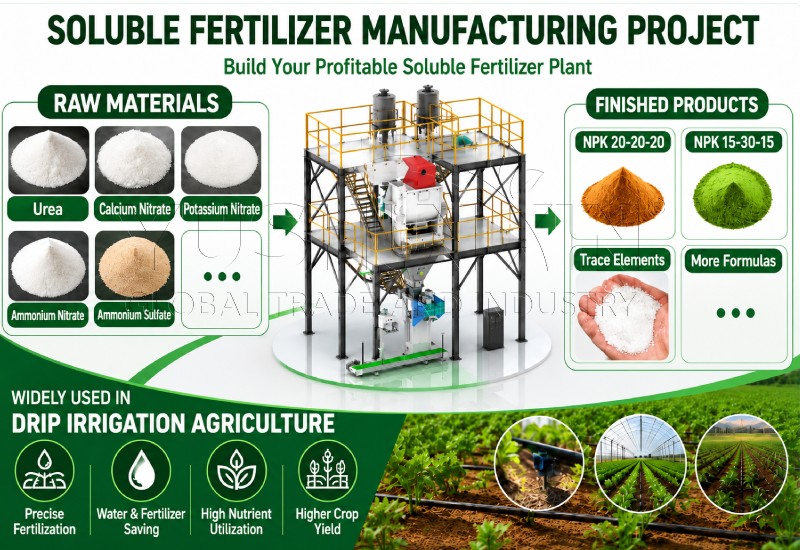
soluble fertilizer manufacturing for drip irrigation farming
Prepare Raw Materials Before Mixing
Many soluble-fertilizer projects process urea, ammonium salts, phosphates, potash materials, magnesium sources, and trace elements. These materials may arrive as powders, granules, or moisture-affected lumps. A formula can be correct on paper but still produce uneven batches if the ingredients do not flow consistently.
A dust-free feeding and lump-crushing system for soluble fertilizer materials helps prepare materials before dosing. Feeding stations, bag opening, lump breaking, weighing, and dust collection should be considered as one continuous section instead of as separate purchases.
This arrangement helps the mixer receive a more stable material flow. It also makes formula changes more manageable when different raw materials require different feeding methods.
Match Dosing Accuracy with Formula Requirements
A water-soluble fertilizer plant must control the order and proportion of ingredients before blending. The mixer can distribute a batch, but it cannot correct an incorrect dosing result. For this reason, each key raw material should have a defined weighing and feeding route.
Manufacturers producing balanced or customized grades can also review 20-20-20 NPK batching and mixing options when comparing formulation logic. The same principles apply: reliable ingredient dosing, suitable mixing time, and a practical layout between batching and packaging.
Select Materials That Suit the Production Environment
Some soluble fertilizer ingredients can absorb moisture or create corrosive working conditions. Equipment selection should therefore account for the materials in contact with the product, the required cleaning practice, and the local humidity level.
A stainless-steel mixing and packaging line for water-soluble fertilizer can be appropriate where corrosion resistance and clean handling are important. However, the material choice should be based on the actual formula and operating environment, not applied uniformly to every part of the plant.
Packaging also needs to protect the finished fertilizer from moisture after mixing. A buffer hopper can help coordinate the rhythm between batch mixing and continuous bagging when the packing section operates at a different pace.
Keep the Layout Ready for Growth
A compact plant may suit a new regional fertilizer brand, while a larger project may need additional raw-material storage, automated feeding, more formula positions, or parallel packing capacity. The process should leave room for these changes without forcing a complete redesign later.
A scalable water-soluble fertilizer plant for custom NPK formulas should connect feeding, crushing, dosing, mixing, buffer storage, and packaging in a short, logical path. This reduces unnecessary transfer points and makes daily operation easier to manage.
Before deciding on equipment, compare your raw-material form, formula range, required output, local humidity, operator availability, and finished-bag specifications. To compare a configuration around these conditions, review the complete production plan.
https://www.fertilizerbusinessplan.com/water-soluble-fertilizer-production-solution/