
Garlic, ginger, and spice powders carry strong aroma, so heat drying costs the flavor that buyers pay for. However, a 50kg/batch freeze-dried food production line holds that aroma inside the cell. Each freeze-dried food production line that Hadof builds covers washing, cutting, freezing, drying, and packing as one matched set. Meanwhile, a batch weight of 50kg/batch keeps the daily plan simple for mid-size spice factories.
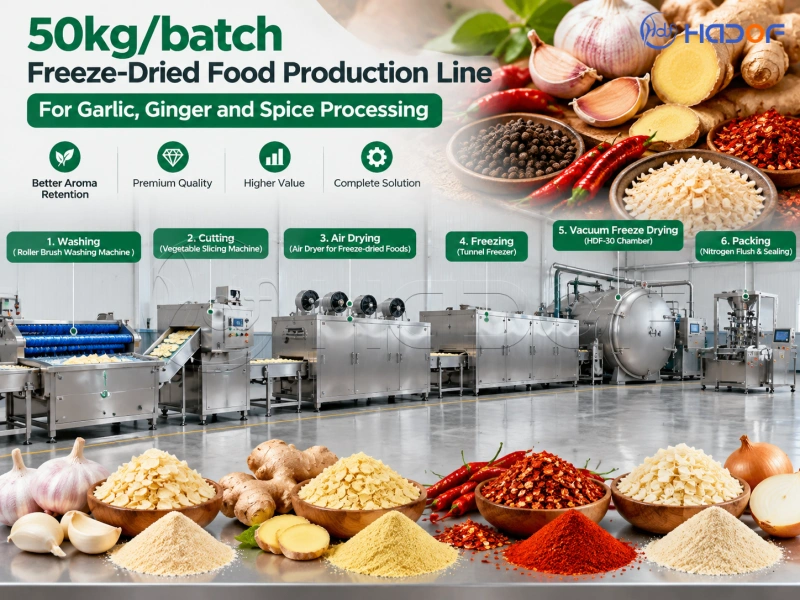
Building a 50kg batch Freeze-Drying Line for Garlic, Ginger and Spice Processing
Which Garlic, Ginger and Spice Materials Fit This Line?
Fresh garlic holds allicin and volatile oils, so fast freezing protects that value. Ginger root carries fiber and moisture, and it dries well after even slicing. Spices such as onion, chili, and pepper also fit, because a chamber handles every recipe at low temperature. Each material sets its own slice size, tray depth, and cycle length. What’s more, a minced product needs a different handling path than a sliced one. Therefore, one line serves several SKUs when the design stays flexible. Because aroma compounds sit near the surface, gentle handling matters more than raw speed.
How Much Output Does a 50kg/batch Freeze-Dried Food Production Line Deliver?
Output depends on cycle length, tray load, and reload speed between cycles. A 50kg/batch freeze-dried food production line for spices pairs with a matched HDF-30 chamber. That chamber removes at least 450 kg of water per batch, so deep wet loads still finish on time. Because shelf area reaches 30.3 m² across 11+1 layers, every tray carries an even load. Then operators reload trays while the condenser defrosts, so the chamber rarely idles. Therefore, daily output grows through a tighter rhythm rather than a bigger machine.
How Does the Process Flow From Raw Bulb to Sealed Pouch?
Garlic and ginger arrive dirty, so washing comes first. Then a roller brush stage scrubs soil from peel and crevices, because water alone leaves grit behind. After that, a slicer cuts bulbs and roots into even flakes or cubes. Next, an air dryer strips surface water, so the freezing stage wastes no energy on free water. Finally, a tunnel freezer locks the cell structure before trays enter the chamber. Inside the chamber, pressure drops to 5 Pa, so ice turns straight into vapor. The condenser traps that vapor, while the load moves toward packing. One steady packing rhythm seals each pouch before humid air returns moisture. Any missing step shows up later as browning, wet centers, or weak aroma.
What Equipment Makes Up the Complete Line?
Hadof designs the six sections below as one matched set, so each station feeds the next at the same rate.
- Pre-treatment Equipment
A roller brush washing machine scrubs soil from peel and crevices, while blanching stabilizes color. Next, an air dryer for freeze-dried foods removes surface water, so cuts stay clean.
- Cutting Equipment
A vegetable slicing machine sets one uniform piece size across the batch. Even pieces dry at the same speed, so no tray stays wet. Blunt blades crush cells, so a sharp set protects texture and yield.
- Freezing Equipment
Tunnel freezing drops core temperature fast, so small ice crystals protect cell walls. Cycle time then follows load depth rather than machine size. Slower freezing also raises power use per kilogram of wet load.
- Conveying Equipment
Belt and bucket conveyors link washing, cutting, freezing, and packing into one flow. Gentle transfer also reduces breakage on fragile flakes. Transfer speed between stations then sets the overall line rate.
- Vacuum Freeze Drying Equipment
The HDF-30 chamber dries the frozen load under vacuum at 5 Pa. Shelf temperature runs from -45 °C to +80 °C, so every recipe stays repeatable. Spray defrost between cycles keeps daily throughput steady.
- Packing Equipment
Right after drying, a nitrogen flush and a tight seal block moisture during sea transit. Seal testing confirms barrier quality before cases leave the plant.
What Parameters and Technical Advantages Matter?
Parameter choice decides cycle time, energy cost, and product consistency across every batch.
| Parameter | Typical Value |
| Shelf area | 30.3 m² (11+1 layers) |
| Water catch capacity | ≥450 kg/batch |
| Ultimate vacuum | ≤5 Pa |
| Condenser temperature | -60 °C to -65 °C |
| Shelf temperature range | -45 °C to +80 °C |
| Installed power | 120 kW |
| Power supply | 380 V, 3 phase, 50 Hz |
| Machine dimensions | 7800 × 2200 × 2800 mm |
Spray defrost shortens cleaning between cycles, so daily uptime stays high. Also, a deep condenser temperature protects aroma even on long cycles. And steady vacuum keeps ice sublimation even from the first hour to the last.
How Do You Plan Price and Floor Space for the Line?
Cost and layout work together, so plan the building around the chamber first. An HDF-30 unit measures about 7800 × 2200 × 2800 mm, and that footprint sets the clear height you need. Then add aisle space for loading, unloading, and maintenance around the frame. Wet preparation areas near washing and cutting need floor drains and easy cleaning access. Also, power planning matters, because this class of machine draws 120 kW at 380 V. Such a layout removes the need for lifts and keeps transfer routes short. Besides, placing packing close to the chamber door limits exposure time for dried product. Truck access and door width then decide how the chamber arrives on site. Therefore, one accurate floor plan usually lowers both civil work and daily labor.
Which Problems Does a 50kg/batch Line Remove?
Single-machine setups often stall at the handover points, and those stalls cost more than the machines themselves. One complete line therefore removes manual re-handling between stations. Even cutting and dewatering shorten cycle time, so the chamber turns more batches each month. Matched freezing protects texture, which keeps premium buyers interested. Sealed packing right after drying protects aroma through long transit. Uneven drying also shows up in complaints, so quality control costs more after shipment. As a result, labor planning gets simpler, because fewer operators touch each load. Such a line therefore protects the margin that spice exports earn. What’s more, one supplier for the full line keeps spare parts and service in one place.
Build the Freeze-Dried Garlic Line as One System
Every stage either protects the dried product or spends it, so one design should cover the whole line. Next, washing, cutting, freezing, drying, and packing run to a single rhythm. Hadof builds garlic, ginger, and spice lines around your raw material, output, and plant area. For a customized solution, visit the Hadof freeze dryer homepage at https://www.freezehadof.com/.