
A proper factory layout is an important part of building an efficient fertilizer production project. When planning an npk blending fertilizer production line, investors need to consider raw material storage, production flow, equipment arrangement, packaging area, and future expansion. A well-designed layout can reduce material handling distance, improve production efficiency, and create a safer working environment.
Plan the Layout According to Material Flow and Production Process
The first step in fertilizer plant layout design is organizing a smooth material flow. Raw materials should move logically from storage to crushing, screening, batching, mixing, and final packaging.
A typical NPK blending process includes raw material feeding, precise weighing, blending, and automatic packing. Therefore, the layout should avoid unnecessary transportation routes and ensure each production section connects efficiently.
For large fertilizer projects, an npk bulk blended fertilizer plant layout usually includes several functional zones:
- Raw material warehouse;
- Automatic batching area;
- Fertilizer blending section;
- Finished product storage;
- Packaging and loading area.
A reasonable arrangement helps operators manage production more easily and also provides better conditions for maintenance.
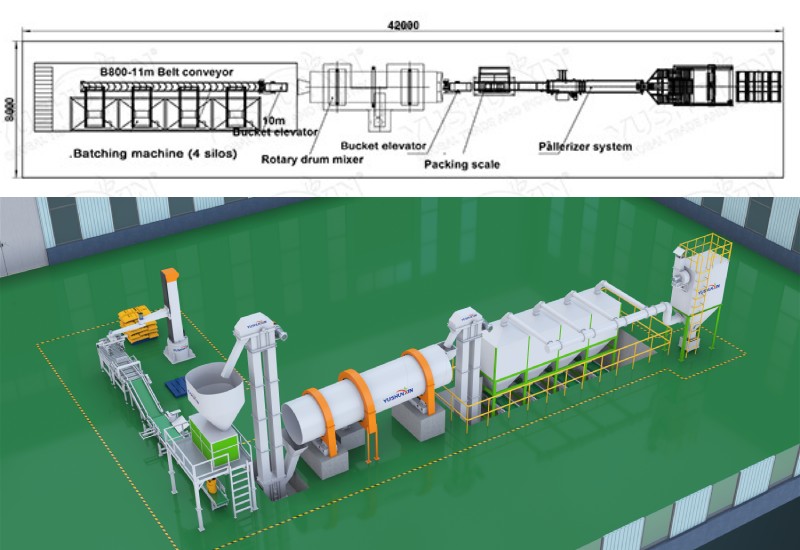
30TPH blend NPK fertilizer production plant design
Consider Space Requirements for Equipment Installation
The available factory area directly affects equipment selection and layout planning. Before designing a fertilizer blending facility, investors need to confirm the building dimensions, material storage requirements, and production capacity.
A complete fertilizer blending facility should reserve enough space for equipment operation, inspection, and future upgrades.
Important layout considerations include:
- Sufficient distance between machines for maintenance;
- Clear transportation routes for forklifts and trucks;
- Separate storage areas for different raw materials;
- Proper ventilation and dust collection arrangements.
For NPK fertilizer production, accurate batching is especially important because different nutrient formulas require precise ingredient ratios. The concept of International Fertilizer Association highlights the importance of fertilizer production efficiency and nutrient management in modern agriculture.
Balance Investment and Production Capacity
Factory layout also influences the overall project investment. A compact design can reduce construction costs, while a flexible layout allows easier expansion when market demand increases.
The NPK bb fertilizer manufacturing plant investmnet depends on many factors, including production capacity, automation level, equipment configuration, and factory conditions.
For example, a small fertilizer blending plant may focus on simple operation and lower initial investment. However, an industrial project may require automatic batching systems, multiple packaging lines, and advanced control systems to improve long-term production efficiency.
Case Reference: 15TPH NPK Blending Project in Sri Lanka
Different markets require different layout solutions according to local raw materials, product requirements, and business goals.
The 15tph npk blend fertilizer production solution in Sri Lanka shows how a fertilizer project can be planned according to production capacity and customer requirements. Through reasonable equipment arrangement, the project can achieve stable blending, efficient packaging, and convenient operation.
Before starting a fertilizer plant project, investors can prepare information about raw materials, expected output, factory dimensions, fertilizer formulas, and automation requirements. Engineers can then provide a more suitable layout and equipment configuration.
More details about NPK fertilizer blending solutions:
https://www.mixedfertilizermachines.com/products/npk-fertilizer-blending-plant/
Conclusion
NPK blending fertilizer production line layout design is not only about placing machines inside a factory. It requires comprehensive planning of material flow, production efficiency, equipment maintenance, and future development.
A practical layout helps fertilizer manufacturers improve operation stability and build a production facility that matches their business goals.
